
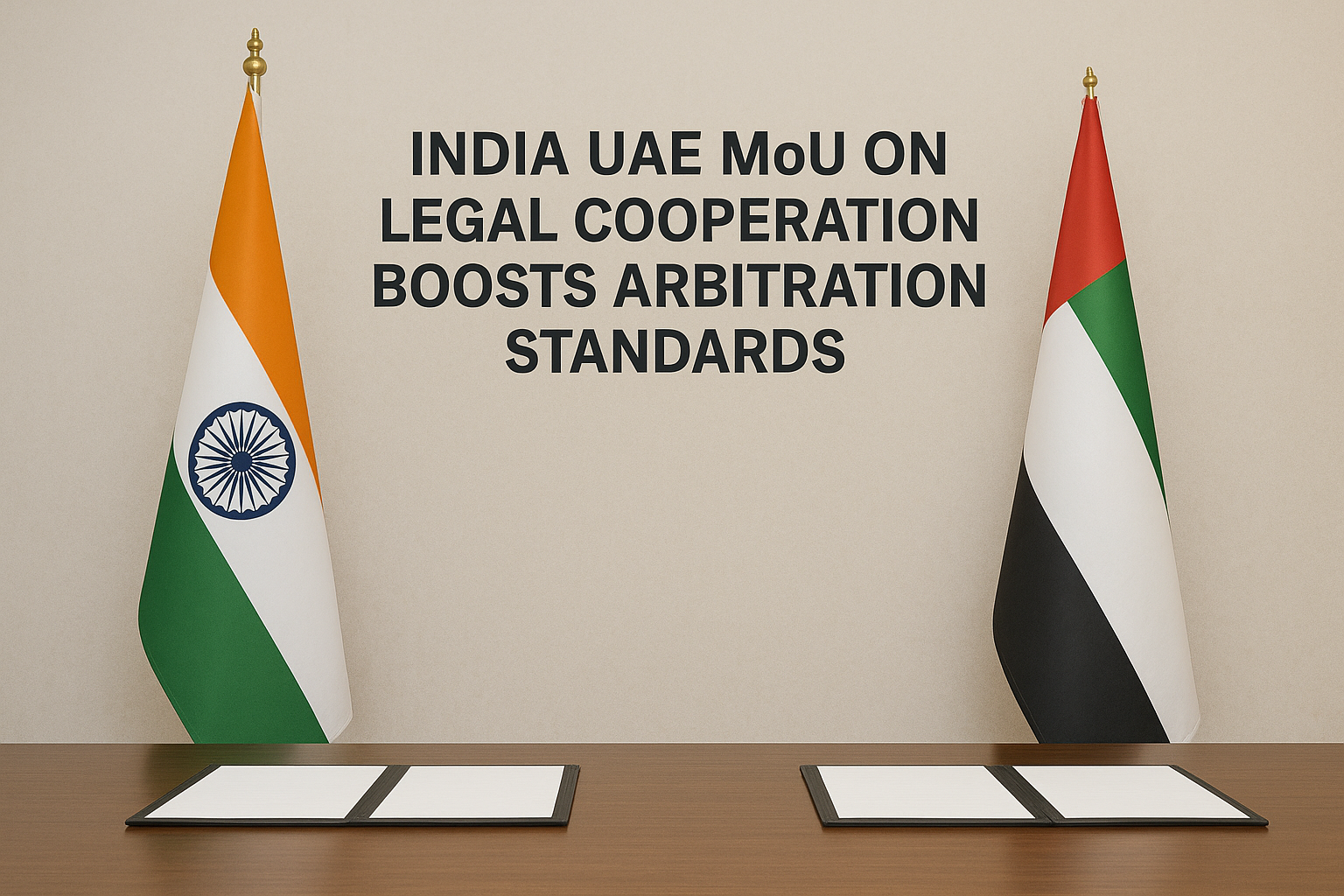
The recently announced India UAE MoU on Legal Cooperation marks a strategic step toward harmonising legal processes and improving cross-border dispute resolution between two fast-growing economic partners. By creating clearer judicial channels for civil and commercial matters, the agreement aims to reduce friction, speed up enforcement of judgments and arbitral awards, and give businesses greater confidence when operating across both jurisdictions.This blog is a part of our service In House Legal Solutions.
This new cooperation enhances the region’s business ecosystem and empowers corporations, investors, and legal practitioners with a clearer framework for cross-border dispute management. As arbitration continues to rise as the preferred method for resolving international commercial disputes, the MoU sets the foundation for smoother legal engagement between the two nations.
Why this MoU matters
The India UAE MoU on Legal Cooperation is important because it supplements existing treaties and bilateral instruments that have gradually built legal trust between the countries. Practical measures — such as streamlined service of documents, cooperation on judicial assistance, and clearer procedures for recognizing foreign arbitral awards — make arbitration a more predictable and attractive dispute-resolution option for investors and traders. These institutional improvements reinforce the legal architecture that already supports strong India–UAE trade and investment ties.
Strengthening Cross-Border Legal Confidence
One of the most significant benefits of the India UAE MoU on Legal Cooperation is its ability to reinforce trust within the business community. Investors from both sides have long sought a streamlined process for court-to-court communication, document exchange, and recognition of judgments. The agreement delivers exactly that.
Businesses often face delays in serving notices, executing arbitral awards, or interpreting documents under different legal systems. This MoU introduces simplified channels that reduce such bottlenecks. The clarity and consistency it offers make it easier for companies to include cross-border arbitration clauses in contracts—knowing that enforcement is less complicated and more predictable.
Practical benefits for businesses and practitioners
For companies and counsel, the India UAE MoU on Legal Cooperation brings several immediate advantages:
-
-
Faster enforcement: Easier execution of judgments and awards decreases time and cost.
-
Predictability: Harmonised procedures reduce legal uncertainty in cross-border contracts.
-
Case management: Better judicial communication helps avoid parallel proceedings and conflicting orders.
-
Investor confidence: A firmer legal framework supports the flow of FDI and commercial activity between India and the UAE.
-
What changed on the ground (quick legal context)
Over recent years, both jurisdictions have updated their arbitration landscapes — the UAE with reforms to federal arbitration law and India with a focus on faster enforcement and arbitration-friendly judicial decisions. The India UAE MoU on Legal Cooperation dovetails with these reforms by creating bilateral mechanisms that make it simpler for parties to rely on arbitration outcomes and for courts to cooperate on enforcement matters.
Tips for companies drafting cross-border contracts
-
Specify seat and governing law carefully. While the MoU boosts cooperation, the choice of seat still affects procedural rules and judicial review.
-
Include clear enforcement clauses. Mentioning arbitration rules (e.g., ICC, LCIA, DIAC) and detailed arbitration clauses reduces later disputes.
-
Plan for document service and evidence transfer. Use the procedures identified under the MoU to anticipate timelines for service and evidence gathering.
-
Use recognised arbitral centres. Consider UAE arbitral institutions for Middle East enforcement ease; Indian parties may prefer neutral seats when appropriate.
Policy and diplomatic significance
Beyond commerce, the India UAE MoU on Legal Cooperation represents a diplomatic deepening: it demonstrates mutual willingness to align legal standards and cooperate institutionally. This contributes to stronger strategic ties and makes bilateral economic frameworks — including CEPA and the 2024 BIT — more effective in practice.
Potential challenges to monitor
-
-
Implementation consistency: MoUs depend on effective domestic implementation; monitoring how courts and agencies apply the new procedures will be essential.
-
Jurisdictional overlaps: Parties should watch for conflicts between local laws and bilateral procedures and draft contracts to minimise ambiguity.
-
Evolving legal reforms: Both countries are continuing legal reforms (especially on arbitration) — staying updated will be important for practitioners and businesses.
-
Why Arbitration Standards Matter
Arbitration is widely considered the backbone of global dispute resolution because it is quicker, confidential, and less adversarial than traditional litigation. The UAE, particularly Dubai and Abu Dhabi, has become a global hub for arbitration with its leading institutions, while India has been reforming its arbitration laws to align with global standards.
The India UAE MoU on Legal Cooperation supports these ongoing reforms by ensuring:
-
-
Faster enforcement of foreign arbitration awards
-
Improved cooperation between judicial authorities
-
Clear frameworks for exchanging legal documents
-
Assistance in obtaining evidence for arbitration cases
-
Reduced duplication of proceedings in parallel jurisdictions
-
Together, these improvements reduce legal uncertainty and promote fairness, transparency, and efficiency for all parties involved.
The India UAE MoU on Legal Cooperation is a pragmatic, forward-looking measure that strengthens arbitration and judicial cooperation between two major trade partners. For businesses, legal teams, and international arbitrators, it offers improved predictability and a firmer enforcement environment — key ingredients for cross-border commerce to thrive.

Rinu Ann George is an SEO Analyst at Upgraderz,Specializing in Search Engine Optimization,Content Strategy and Digital Visibility.