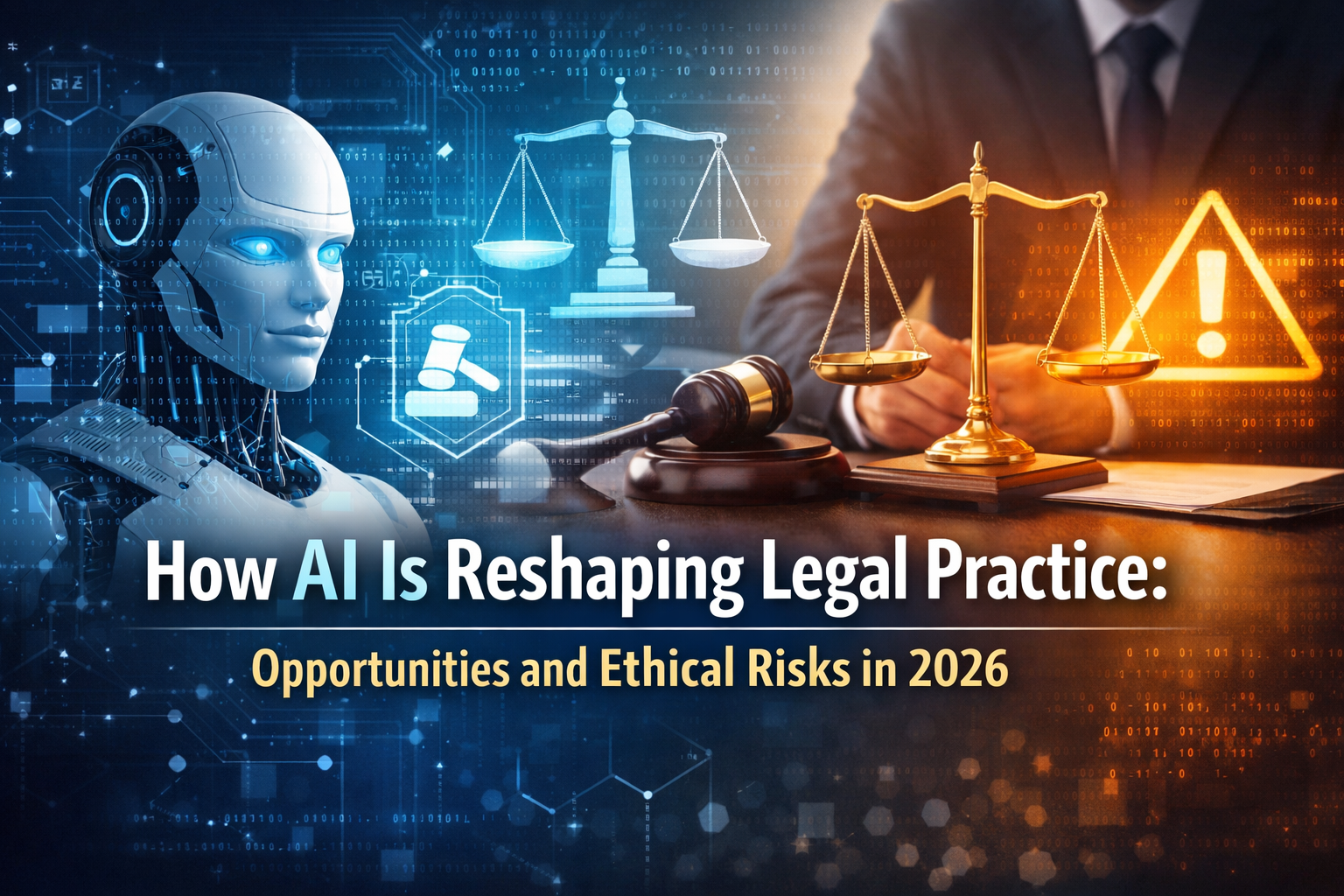
Artificial Intelligence (AI) is no longer a futuristic concept in the legal industry—it is a present-day reality. By 2026, AI has become deeply integrated into legal practice, transforming how lawyers research cases, draft documents, manage contracts, and interact with clients. Law firms and legal departments are adopting AI-powered tools to improve efficiency, reduce costs, and deliver faster results. However, alongside these opportunities, ethical risks have emerged as a critical concern.
This blog explores how AI is reshaping legal practice in 2026, highlighting key opportunities while focusing on the ethical risks that legal professionals must carefully manage to maintain trust, fairness, and professional integrity.
The Growing Role of AI in Legal Practice
AI technologies such as machine learning, natural language processing (NLP), and generative AI are now widely used across the legal sector. Common applications include:
- Legal research and case analysis: AI tools can analyze thousands of cases, statutes, and judgments in seconds.
- Document review and e-discovery: Automation helps identify relevant documents quickly during litigation.
- Contract drafting and review: AI assists in spotting risks, inconsistencies, and compliance issues.
- Predictive analytics: AI can estimate case outcomes based on historical data.
- Client interaction: Chatbots and virtual assistants provide basic legal guidance and updates.
These advancements have redefined productivity standards in law firms and legal departments worldwide.
Opportunities Created by AI in the Legal Sector
Increased Efficiency and Cost Reduction
One of the biggest advantages of AI is efficiency. Tasks that once took hours or days—such as document review—can now be completed in minutes. This allows lawyers to focus on high-value work like strategy, advocacy, and client counseling, while reducing operational costs.
Improved Accuracy and Consistency
AI-powered legal tools minimize human error by maintaining consistency in document review and legal research. When trained correctly, AI systems can flag missing clauses, conflicting terms, and compliance gaps more reliably than manual processes.
Enhanced Access to Legal Services
AI-driven platforms are making legal services more accessible, especially for small businesses and individuals. Automated tools can offer affordable legal assistance, bridging the gap between legal professionals and underserved communities.
Data-Driven Decision Making
With predictive analytics, lawyers can assess risks more accurately and advise clients based on data-backed insights. This improves litigation strategy, settlement decisions, and overall case management.
Ethical Risks of AI in Legal Practice
Despite these benefits, the rise of AI in law introduces serious ethical risks that cannot be ignored.
Bias and Discrimination
AI systems learn from historical data, which may contain biases related to race, gender, or socioeconomic status. If unchecked, these biases can influence legal predictions, sentencing recommendations, or case evaluations, leading to unfair outcomes. Addressing ethical risks related to bias is crucial to ensuring justice and equality.
Lack of Transparency and Explainability
Many AI systems operate as “black boxes,” making it difficult to understand how decisions are reached. In legal practice, this lack of transparency poses ethical risks, as lawyers must be able to explain and justify decisions to clients, courts, and regulators.
Confidentiality and Data Privacy
Lawyers handle highly sensitive client information. Using AI tools increases ethical risks related to data security, confidentiality breaches, and unauthorized access. If client data is mishandled or exposed, it can damage trust and violate professional conduct rules.
Over-Reliance on AI
Another major ethical risk is excessive dependence on AI-generated outputs. While AI can assist legal professionals, it cannot replace human judgment, reasoning, and ethical responsibility. Blind reliance may result in flawed legal advice or overlooked nuances.
Accountability and Responsibility
When AI systems make errors, determining accountability becomes complex. Who is responsible—the lawyer, the firm, or the AI vendor? This ambiguity creates ethical risks related to professional liability and regulatory compliance.
Regulatory and Professional Challenges in 2026
As AI adoption increases, bar councils and legal regulators worldwide are introducing guidelines to address ethical risks. In 2026, legal professionals are expected to:
- Understand how AI tools function
- Supervise AI-generated work
- Ensure compliance with data protection laws
- Maintain transparency with clients about AI usage
Failure to follow these standards may lead to disciplinary action, reputational damage, or legal consequences.
Balancing Innovation with Ethical Responsibility
To manage ethical risks effectively, law firms and legal professionals should adopt a balanced approach:
- Human oversight: Always review AI outputs critically.
- Bias audits: Regularly test AI systems for unfair patterns.
- Data security measures: Use secure platforms and comply with privacy laws.
- Clear policies: Establish internal guidelines for responsible AI use.
- Client disclosure: Inform clients when AI tools are part of legal service delivery.
By embedding ethics into AI adoption, legal professionals can harness innovation without compromising professional value
In 2026, AI is undeniably reshaping legal practice by improving efficiency, accuracy, and access to legal services. However, these advancements come with significant ethical risks that demand careful attention. Bias, transparency issues, data privacy concerns, and accountability challenges highlight the need for responsible AI use in the legal profession.
The future of law depends not only on technological innovation but also on ethical integrity. By proactively addressing ethical risks, legal professionals can ensure that AI serves as a powerful ally—enhancing justice rather than undermining it.