
Business laws that regulate modern companies did not develop overnight. Many of the rules guiding corporations, investors, and entrepreneurs today were shaped by historic judicial decisions. Businesses often rely on expert legal support to navigate these complex regulations, and services like In House Legal Solutions, a specialized service offered by Lawgig, help companies manage legal risks, compliance, and corporate governance efficiently. These Court Cases That Changed Business Law have influenced corporate rights, antitrust regulations, intellectual property protection, and the relationship between businesses and governments.
Understanding these historic rulings helps business owners and legal professionals recognize how modern commercial law evolved. The following landmark cases are among the most influential Court Cases That Changed Business Law and continue to affect corporate governance, competition, and market regulations worldwide.
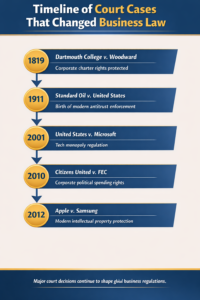
Dartmouth College v. Woodward (1819)
One of the earliest Court Cases That Changed Business Law is the Dartmouth College v. Woodward case. In this case, the government of New Hampshire attempted to alter Dartmouth College’s charter and convert it into a public institution.
The court ruled that a corporate charter is a contract and cannot be changed by the government without consent. This decision strengthened corporate protections and laid the foundation for modern corporate law. It confirmed that businesses have contractual rights that must be respected by state governments.
Standard Oil Co. v. United States (1911)
Another landmark among the Court Cases That Changed Business Law is Standard Oil Co. v. United States. At the time, Standard Oil controlled a massive share of the oil industry in the United States.
The government accused the company of monopolistic practices that violated the Sherman Antitrust Act. The Supreme Court ruled that Standard Oil must be broken into several smaller companies to restore competition in the market.
This case became a cornerstone of antitrust law and set a precedent for regulating monopolies. It demonstrated that governments can intervene when companies gain excessive control over an industry.
Brown v. Board of Education (1954) and Its Business Impact
While primarily known as a civil rights case, Brown v. Board of Education also influenced business policies and workplace equality. Many corporations began reevaluating hiring practices and workplace diversity after this decision.
The broader social impact of such rulings indirectly shaped corporate responsibility and workplace policies, making it one of the indirect Court Cases That Changed Business Law through its influence on employment practices.
United States v. Microsoft (2001)
One of the most significant modern Court Cases That Changed Business Law involved Microsoft. The U.S. government accused Microsoft of abusing its dominance in the software industry by restricting competition.
The case highlighted how antitrust laws apply to technology companies. Although Microsoft avoided being split into multiple companies, the ruling forced the company to change certain business practices and allowed competitors greater market access.
This case reshaped how regulators view technology monopolies and digital market competition. It also became a reference point for later investigations involving large tech companies.
Citizens United v. Federal Election Commission (2010)
Citizens United v. FEC is another major example of Court Cases That Changed Business Law. The ruling allowed corporations and unions to spend unlimited funds on political campaigns through independent expenditures.
The court argued that political spending is a form of free speech protected by the Constitution. This decision dramatically changed the relationship between corporations and political campaigns.
As a result, businesses gained greater influence in political advocacy and public policy discussions, significantly impacting corporate governance and political finance laws.
Apple Inc. v. Samsung Electronics (2012)
The global technology industry closely followed the Apple v. Samsung case. The dispute focused on smartphone design patents and intellectual property rights.
The court ruled that Samsung had infringed several of Apple’s patents related to smartphone design and user interface features. This case became one of the most well-known Court Cases That Changed Business Law regarding intellectual property protection in the technology sector.
It reinforced the importance of patent protection for innovation and encouraged companies to invest more heavily in protecting their designs and technologies.
Why These Court Cases Matter Today
These Court Cases That Changed Business Law helped define the rules that companies must follow today. They shaped areas such as corporate rights, antitrust enforcement, intellectual property protection, and political participation by businesses.
For entrepreneurs and business leaders, understanding these cases provides insight into how legal decisions influence markets and corporate behavior. It also highlights how courts continue to shape the evolving relationship between businesses, governments, and society.
What Was the Most Famous Court Case
While many rulings have had major impacts, Standard Oil Co. v. United States (1911) is often considered one of the most famous business-related court cases. Its decision to break up Standard Oil established a powerful precedent for antitrust enforcement and demonstrated the government’s authority to regulate monopolies.
Even today, regulators reference this case when examining large corporations and market dominance in industries such as technology, telecommunications, and finance.
The evolution of modern business regulations owes much to historic legal battles. These Court Cases That Changed Business Law established precedents that continue to guide corporate behavior, competition policies, and innovation protection.
From the corporate rights established in Dartmouth College v. Woodward to the technology battles between Apple and Samsung, these rulings have shaped how companies operate in the modern economy. As industries evolve, future court decisions will continue to redefine the legal landscape for businesses worldwide.

Rinu Ann George is an SEO Analyst at Upgraderz,Specializing in Search Engine Optimization,Content Strategy and Digital Visibility.