

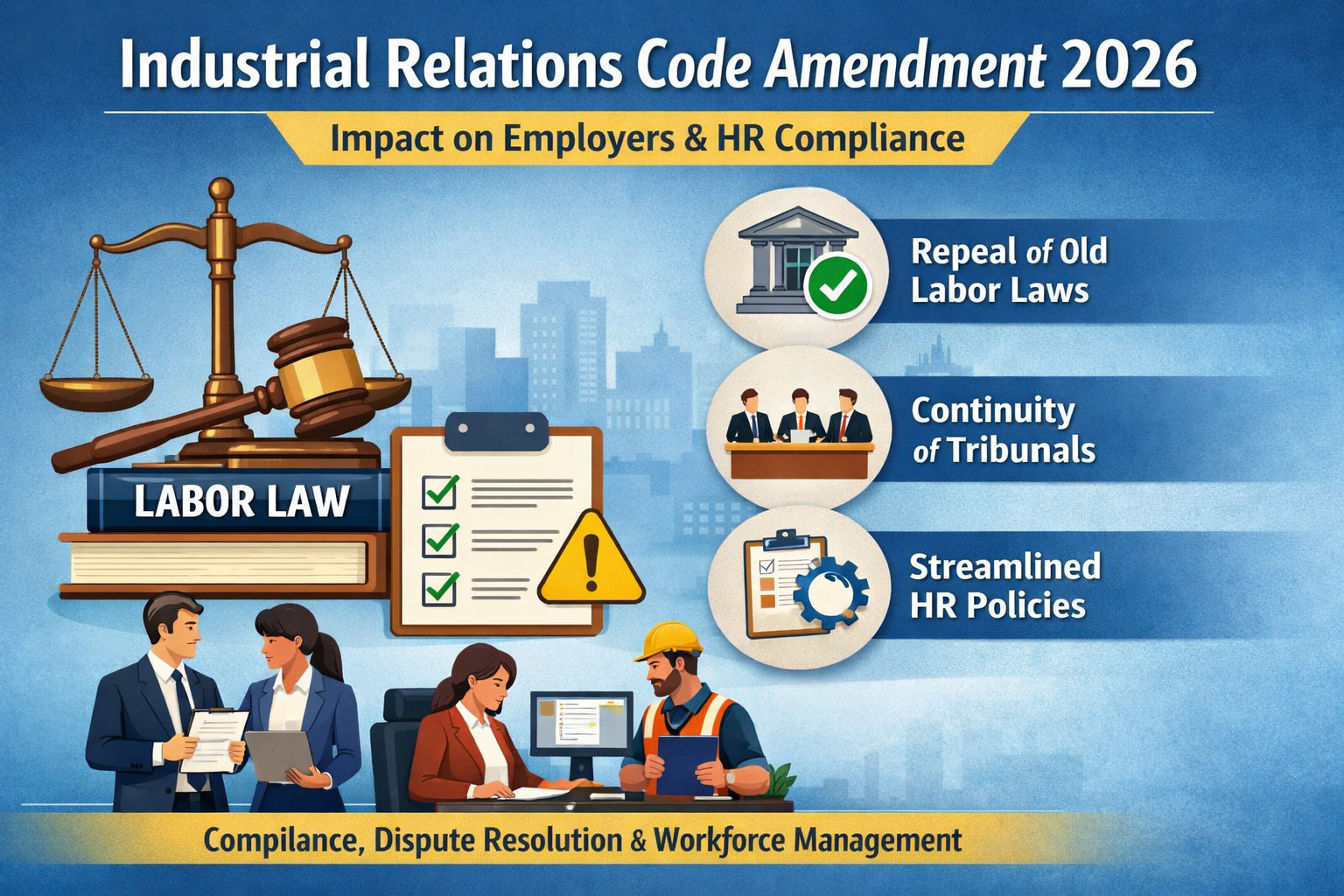
In February 2026, the Indian Parliament passed the Industrial Relations Code Amendment 2026, marking a key update in India’s labour law framework. This Amendment is not just a technical tweak; it addresses long-standing legal ambiguities in the Industrial Relations Code, 2020 and has direct consequences for employers, HR teams, and labour compliance functions across industries.
In this blog, we’ll break down what the Amendment is, why it was introduced, and how it affects employers and Human Resources compliance strategies.
What Is the Industrial Relations Code Amendment 2026?
The Industrial Relations Code Amendment 2026 was introduced as part of comprehensive labour law reforms in India. The Amendment primarily clarifies the repeal of older labour laws — including the Trade Unions Act of 1926, the Industrial Employment (Standing Orders) Act of 1946, and the Industrial Disputes Act of 1947 — which were subsumed under the Industrial Relations Code, 2020.
While the Industrial Relations Code, 2020 already consolidated these historic statutes, the 2026 Amendment ensures legal certainty regarding the continuity and repeal of these laws, closing any loopholes that might create disputes or litigation in the future.
The primary purpose of this Amendment is not to introduce wholly new compliance obligations on employers, but to solidify and smooth the transition into the unified labour code regime.
Why Was the Amendment Needed?
Prior to the Amendment, there was some ambiguity over whether the 2020 Industrial Relations Code had effectively repealed legacy laws or whether those were repealed by notification or delegated executive action. This opened the door to potential legal challenges.
The Amendment solves this ambiguity by explicitly stating that:
-
The old Acts have been repealed by the Industrial Relations Code itself.
-
The repeal is statutory and not delegated to an executive authority.
-
Existing institutional mechanisms, such as labour tribunals, continue to function during the transition to the new framework.
This is important because it gives employers and HR compliance teams greater certainty about the legal framework they operate in — a major step in making compliance more predictable.
Key Impacts of the Amendment on Employers
While the 2026 Amendment does not drastically change substantive labour law rights, it affects employers in several important ways — especially from a compliance and HR standpoint:
Legal Certainty Reduces Litigation Risks
One of the biggest challenges for employers over the last few years has been navigating conflicting interpretations of old labour laws versus new codes. The Amendment eliminates this confusion. By clarifying that legacy laws are repealed directly by statute, businesses face fewer legal disputes over which law applies.
HR teams can thus be more confident in basing policies, contracts, and compliance reporting solely on the new codes rather than maintaining a dual system.
Continuity of Tribunals & Industrial Mechanisms
The Amendment also ensures that existing tribunals and statutory bodies — such as industrial tribunals that previously functioned under repealed laws — continue to operate until their counterparts under the Industrial Relations Code, 2020 are fully functional.
For employers, this means:
-
Ongoing disputes don’t stall due to administrative gaps.
-
There’s clarity on where cases should be filed and adjudicated.
-
HR can prepare for a smooth shift to new dispute resolution forums.
This continuity is crucial for labour-intensive industries where disputes arise more frequently.
HR Compliance Framework Becomes More Predictable
Since the Amendment resolves legal doubts, HR teams can streamline compliance systems more effectively. Before the Amendment, some employers hesitated to fully revise policies, fearing future legal challenges tied to older laws.
Now, employers can confidently update:
-
Employment contracts
-
Standing orders and shop rules
-
Dispute resolution procedures in HR manuals
-
Industrial relations policies
This reduces administrative burden and strengthens compliance documentation.
Simplified Record-Keeping & Reporting
One indirect benefit of the Amendment is that it reinforces the transition from the old fragmented labour law system to the four unified codes (Wages, Industrial Relations, Social Security, and OSHWC).
This unification makes record-keeping and reporting more streamlined, since:
-
Employers maintain fewer overlapping registers.
-
Central HR software can consolidate multiple compliance workflows.
-
Digital filings and returns are easier across a standardised system.
For HR compliance teams already adjusting to new wage definitions, employee categories, and digital labour returns portals, this is a welcome change.
Better Predictability for Workforce Strategy
With clearer legal foundations, employers can align workforce planning to the new framework without fear of sudden retroactive liabilities. For example:
-
Hiring strategies around contract and fixed-term workers can align with updated Industrial Relations Code rules.
-
Industrial actions like strikes and lockouts are dealt with within a uniform legal regime.
-
Employers can restructure internal disciplinary and grievances procedures to align with the unified code.
All of these outcomes flow from the legal certainty that the 2026 Amendment adds to the labour law landscape.
What Employers Should Do Next
While the Industrial Relations Code Amendment 2026 does not introduce sweeping new obligations, employers and HR teams should take practical steps to ensure smooth compliance:
Conduct a Policy Audit
Review existing industrial relations policies and ensure they are fully aligned with the unified labour codes. Remove outdated references to repealed laws.
Update Employment Contracts
Make sure contracts reflect compliance with the Industrial Relations Code, 2020 and do not reference superseded statutes.
Train HR Teams
Educate HR and compliance teams on new dispute resolution processes, thresholds for standing orders, and the practical effects of the Amendment.
Leverage Digital Compliance Tools
Use digital platforms for filing returns, maintaining records, and monitoring compliance across codes.
Stay Updated on State Rules
Labour codes often require supporting state rules for implementation. Some states are still finalising these, so employers should monitor local notifications.
The Industrial Relations Code Amendment 2026 is a critical legal development that brings stronger clarity to India’s new labour law architecture. By removing ambiguity around the repeal of old laws and ensuring continuity in industrial dispute mechanisms, the Amendment gives employers and HR compliance teams a more stable foundation to operate on.
For organisations — whether large enterprises or MSMEs — embracing this Amendment means strengthening compliance systems, reducing litigation risks, and simplifying labour relations management across the board.
As India’s labour law regime continues to evolve, staying ahead of such reforms and integrating them into HR processes will define future-ready workplaces.
