

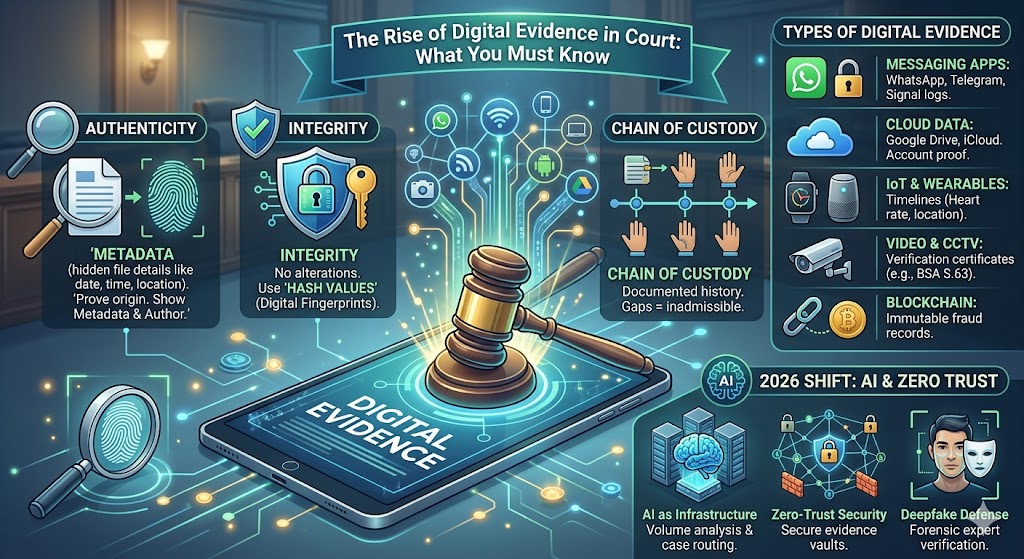
In today’s fast-evolving technological landscape, the legal system is rapidly adapting to new forms of proof. One of the most significant developments is the increasing reliance on Digital Evidence in court proceedings. From emails and text messages to CCTV footage and social media activity, modern cases are now heavily influenced by digital data.
The term Digital Evidence refers to any data stored or transmitted electronically that can be presented in a court of law. This includes information from mobile phones, computers, servers, and cloud platforms. As digital interactions grow, so does the relevance of such evidence in both civil and criminal litigation.
A major reason behind the rise of Digital Evidence is the widespread use of technology in everyday life. Almost every action leaves behind a trace—whether it’s a financial transaction, a phone call, or a location check-in. These digital footprints can later be retrieved and analyzed. According to insights from platforms like cybersecurityguide, understanding how personal data is stored and used is becoming increasingly important.
Another factor contributing to the importance of Digital Evidence is the advancement of forensic tools. Experts can now recover deleted files, examine metadata, and verify timestamps with high accuracy. These developments have made digital data more credible and acceptable in legal proceedings. Educational resources such as lawteacher.net explain how courts evaluate such evidence.
However, courts do not accept all forms of Digital Evidence without scrutiny. There are strict legal standards that must be met. The evidence must be relevant, authentic, and collected through lawful means. Any sign of tampering or unauthorized access can render it inadmissible. Legal guides like legal-articles provide further clarity on admissibility requirements.
One of the strongest advantages of Digital Evidence is its precision. Unlike human testimony, which can sometimes be unreliable, digital records often provide exact timestamps and unaltered information. For instance, in financial disputes, transaction histories clearly outline the sequence of events, leaving little room for ambiguity.
Despite its advantages, handling Digital Evidence comes with challenges. Ensuring data integrity is one of the biggest concerns. Courts must be certain that the evidence has not been altered. Technologies like encryption and digital signatures help maintain authenticity, but they also require expert handling and interpretation.
Another issue is the overwhelming volume of digital data. Sorting through large datasets to find relevant Digital Evidence can be complex and time-consuming. Legal professionals often depend on specialized tools to filter and analyze information effectively. More insights on this can be found on technology-focused platforms like.
Privacy is another critical concern associated with Digital Evidence. Collecting personal data must be done within legal boundaries to protect individual rights. Unauthorized access or misuse of digital information can lead to serious legal consequences. Therefore, maintaining ethical standards is essential in digital investigations.
The role of Digital Evidence is particularly significant in cases involving cybercrime, fraud, and online harassment. In many such cases, traditional evidence may not exist, making digital records the primary source of proof. This has encouraged law enforcement agencies to invest in advanced digital investigation methods.
Individuals must also be aware that their online behavior can have legal implications. Messages, posts, and browsing activities can all serve as Digital Evidence if required. Being cautious and responsible online is no longer just a personal choice—it is a legal necessity.
Businesses, too, must recognize the importance of maintaining accurate digital records. Proper documentation, secure data storage, and compliance with data protection laws are essential. In disputes, well-maintained records can act as powerful Digital Evidence supporting their case.
Looking ahead, the influence of Digital Evidence will continue to expand. With emerging technologies such as artificial intelligence and the Internet of Things, the volume and variety of digital data will grow significantly. This will further reshape how courts function and how justice is delivered.
In conclusion, Digital Evidence is transforming the legal landscape by offering reliable and precise information. While it brings numerous benefits, it also introduces challenges related to privacy, authenticity, and data management. Understanding these aspects is crucial for navigating the modern legal environment effectively.

Chinnu Sunny
- Chinnu Sunny
- Chinnu Sunny
- Chinnu Sunny