

WhatsApp has become one of the most powerful communication tools for businesses in India. From small startups to large enterprises, everyone is using it to connect directly with customers. However, with this growing usage, understanding WhatsApp Marketing Laws in India has become crucial to avoid legal risks and maintain customer trust.
For businesses entering this space, compliance should always come first. Many companies unknowingly violate regulations by sending unsolicited messages or misusing customer data. Taking proper legal guidance through trusted advisory platforms like Lawgig legal advisory services can help businesses stay compliant and avoid unnecessary penalties.
In this blog, we will explore WhatsApp Marketing Laws in India, including what is legal, what is not, and the latest updates for 2026.
Is WhatsApp Marketing Legal in India
Yes, WhatsApp marketing is legal in India—but only under strict conditions. Unlike traditional marketing channels, WhatsApp is a personal messaging platform, which means user privacy is a top priority.
Businesses are allowed to use WhatsApp for marketing only when they follow proper consent-based communication practices. This ensures that users receive only relevant and expected messages.
To stay legal, businesses must:
-
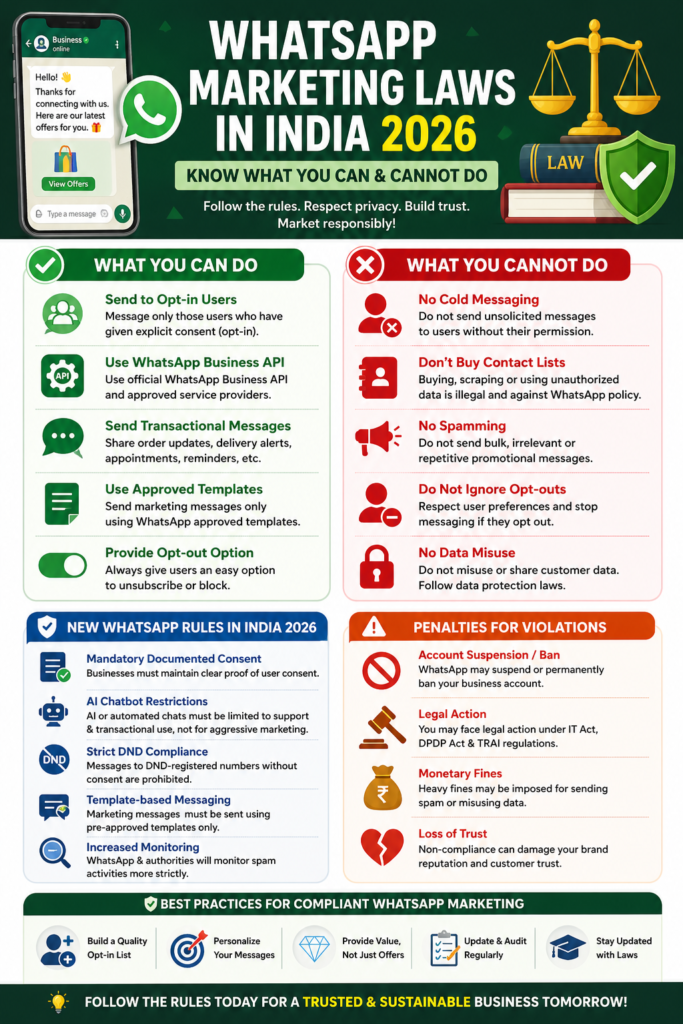
- Obtain explicit user consent (opt-in)
- Send only relevant and expected messages
- Provide an easy opt-out option
- Follow data protection regulations
Failing to follow these basic rules can result in violations of WhatsApp Marketing Laws in India.
What Are the New WhatsApp Rules in India 2026
The WhatsApp Marketing Laws in India have been updated in 2026 to improve user privacy and reduce spam. These changes make compliance more important than ever.
One of the biggest updates is stricter enforcement of consent. Businesses must now maintain clear proof of user opt-in, ensuring transparency in communication. This reduces misuse and protects users from unwanted promotions.
Another major change involves automation and AI usage. While chatbots are still allowed, they must serve specific purposes such as customer support or transactional updates rather than aggressive marketing.
Key updates in 2026 include:
-
- Mandatory documented user consent
- Restrictions on AI-driven promotional chatbots
- Stronger DND compliance enforcement
- Use of approved message templates
- Increased monitoring of spam activities
These updates reflect the growing importance of WhatsApp Marketing Laws in India in the digital ecosystem.
Legal Framework Behind WhatsApp Marketing
To fully understand WhatsApp Marketing Laws in India, it’s important to know the laws that govern them. These regulations work together to ensure ethical and safe communication.
Key laws and policies include:
-
- TRAI Guidelines – Prevent spam and regulate commercial messaging
- DPDP Act, 2023 – Protect user data and privacy
- IT Act, 2000 – Governs digital communication
- WhatsApp Business Policy – Platform-level rules
These frameworks ensure that businesses operate responsibly while using WhatsApp as a marketing tool.
What You CAN Do
When you follow WhatsApp Marketing Laws in India, WhatsApp becomes a highly effective marketing channel. Businesses can legally engage with customers and build strong relationships through personalized communication.
You can send messages to users who have willingly opted in and expect communication from your business. This creates a positive user experience and increases engagement rates.
Allowed practices:
-
- Send messages only to opted-in users
- Use WhatsApp Business API for campaigns
- Share transactional messages (order updates, reminders)
- Provide easy opt-out options
- Maintain transparent communication
Following these practices ensures long-term success without legal complications.
What You CANNOT Do
Ignoring WhatsApp Marketing Laws in India can lead to serious consequences. Many businesses make the mistake of prioritizing reach over compliance, which often results in penalties.
Sending messages without user consent is one of the most common violations. Similarly, using purchased contact lists or spamming users can damage both your reputation and your business operations.
Prohibited practices:
-
- Sending unsolicited (cold) messages
- Buying or scraping contact lists
- Spamming users frequently
- Ignoring opt-out requests
- Misusing customer data
Avoiding these mistakes is critical to staying compliant.
Penalties and Risks
Violating WhatsApp Marketing Laws in India doesn’t just result in minor issues—it can seriously impact your business. Authorities and platforms are becoming stricter in enforcing rules.
Businesses that fail to comply may face both legal and operational consequences. In many cases, even a single violation can lead to account restrictions.
Possible consequences include:
-
- Monetary fines and penalties
- WhatsApp account suspension or ban
- Legal action under data protection laws
- Loss of customer trust and credibility
This is why compliance should always be a priority.
Best Practices for 2026
To succeed while following WhatsApp Marketing Laws in India, businesses must adopt a strategic and ethical approach. Compliance not only protects your business but also improves customer relationships.
Instead of focusing on mass messaging, businesses should prioritize quality communication. Personalized and relevant messages perform better and align with legal requirements.
Best practices to follow:
-
- Build a permission-based contact list
- Focus on personalized messaging
- Share valuable and relevant content
- Regularly update compliance policies
- Monitor engagement and feedback
These steps help businesses grow sustainably while staying compliant.
As digital communication evolves, WhatsApp Marketing Laws in India are becoming stricter and more structured. Businesses that adapt to these changes early will gain a competitive advantage and build stronger customer trust.
The future of WhatsApp marketing depends on:
- Transparency
- User consent
- Responsible data usage
By following these principles, businesses can unlock the full potential of WhatsApp without facing legal risks.

Rinu Ann George is an SEO Analyst at Upgraderz,Specializing in Search Engine Optimization,Content Strategy and Digital Visibility.