

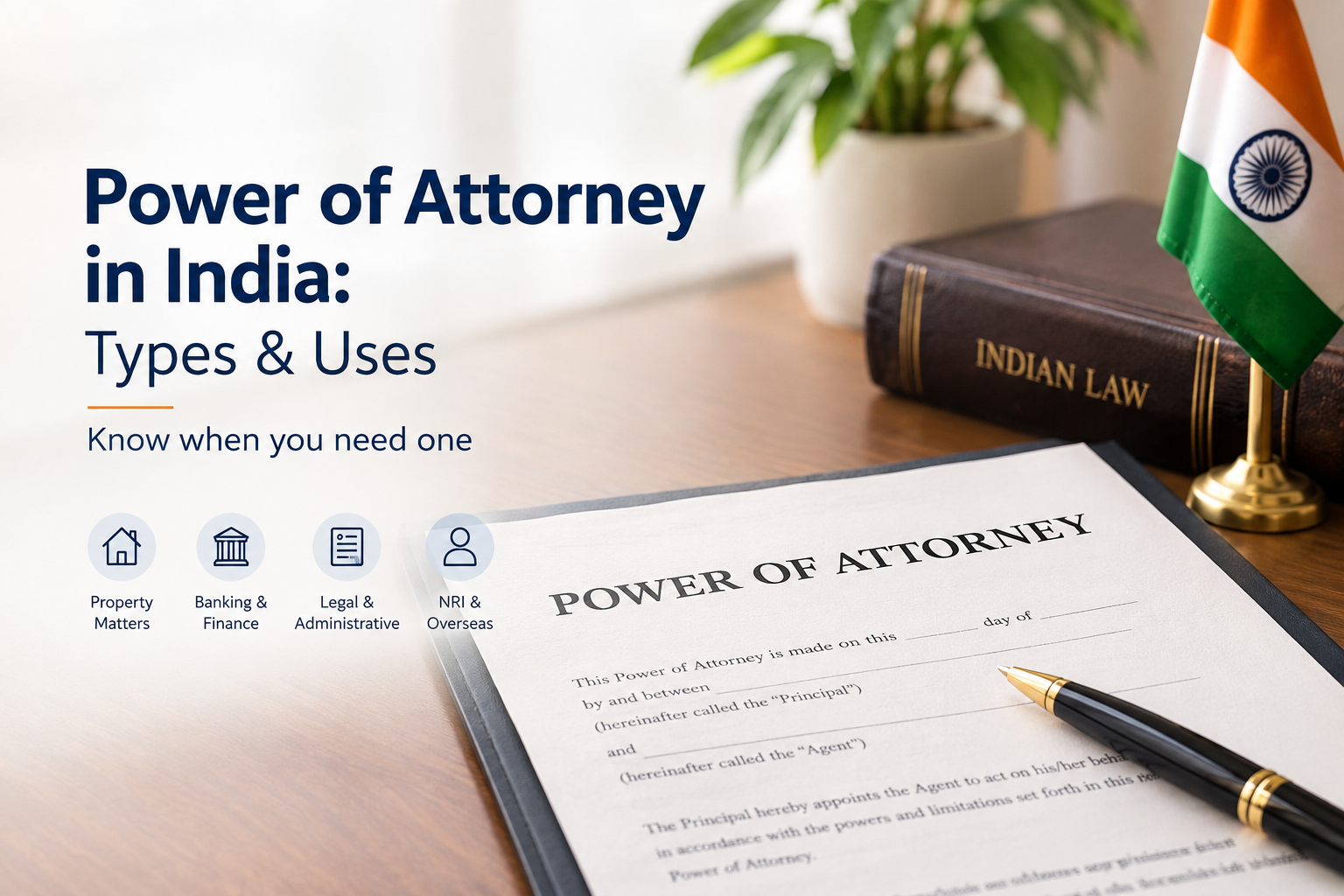
Managing property, financial matters, banking transactions, or legal responsibilities can become difficult when you cannot personally be present. This is where a Power of Attorney in India can be useful. It allows one person to authorise another trusted individual to act on their behalf for specified matters.
A Power of Attorney (POA) is a legal instrument through which a person, known as the principal or donor, gives authority to another person, known as the agent, attorney, or donee, to perform specified acts on their behalf. The Powers-of-Attorney Act, 1882 specifically recognises an instrument that empowers a specified person to act in the name of the person executing it.
What Is a Power of Attorney
A Power of Attorney in India is a legal document that authorises another person to act on your behalf within the powers stated in the document. The authority can be broad or limited depending on the purpose for which the POA is created.
For example, a person living abroad may authorise a family member in India to manage a property transaction. Similarly, someone who cannot visit a bank, government office, or other institution personally may authorise another person to complete specific tasks.
The authority given under a POA depends on its wording. Therefore, the document should clearly specify what the authorised person can and cannot do.
Who Are the Parties Involved
A Power of Attorney generally involves two principal parties:
-
- Principal/Donor: The person granting the authority.
- Agent/Attorney/Donee: The person receiving the authority.
The agent does not automatically receive ownership of the principal’s property merely because a POA has been granted. The agent receives only the authority specifically provided under the document.
Types of Power of Attorney in India
There are different types of POA depending on the scope and purpose of the authority.
General Power of Attorney
A General Power of Attorney (GPA) provides broader authority to the agent to undertake multiple activities on behalf of the principal. Depending on its terms, it may cover property management, financial transactions, documentation, banking matters, or representation before authorities.
Because a GPA can provide extensive powers, the principal should clearly understand every authority included before signing it.
Special Power of Attorney
A Special Power of Attorney (SPA), also known as a specific POA, grants authority for a particular transaction or purpose.
For example, a property owner may authorise someone to appear before an authority and complete documentation relating to one specific property transaction. Once the specified purpose is completed, the authority may no longer be required, depending on the terms of the document.
Durable or Continuing Authority
People sometimes use terms such as “durable power of attorney” when discussing authority intended to continue in particular circumstances. However, the legal effect of a POA depends on the applicable law and the exact wording of the instrument. It is therefore important not to assume that every POA automatically continues in every situation.
When Do You Need a Power of Attorney
A Power of Attorney in India may be considered when you need someone else to legally act on your behalf for specific matters.
Common situations include:
Property Transactions
Property owners who are unable to personally attend certain procedures may authorise another person to handle specified activities. This can be particularly relevant for people living in another city or country.
However, a POA itself should not be confused with a sale deed or a transfer of ownership. The authority granted and the transaction being carried out are separate legal considerations.
Managing Property
A property owner may authorise an agent to handle certain property-related responsibilities, such as dealing with tenants, documentation, or specified administrative matters.
Banking and Financial Matters
Depending on the institution and the wording of the document, a POA may be used to authorise another person to perform particular banking or financial activities.
Government and Legal Procedures
A person who cannot personally attend a particular procedure may authorise an agent to represent them where the relevant authority permits such representation.
NRIs and Overseas Indians
A Power of Attorney in India can be particularly relevant for NRIs who own property or have financial and legal responsibilities in India. Depending on where the document is executed, additional authentication or formalities may apply.
The Registration Act, 1908 contains provisions dealing with powers of attorney used for registration-related purposes, including circumstances where the principal resides outside India.
How to Create a Power of Attorney in India
Creating a Power of Attorney in India requires careful drafting because the agent’s authority is determined largely by the contents of the document.
A typical process involves:
- Identify the purpose: Clearly determine why the POA is required.
- Choose the agent: Select a trusted person who can responsibly perform the authorised duties.
- Define the powers: Specify exactly what the agent can and cannot do.
- Prepare the document: Include the identities of the parties, powers granted, limitations, duration where applicable, and other relevant terms.
- Execute the document: The principal must sign it according to the applicable legal requirements.
- Complete applicable formalities: Depending on the purpose and transaction, notarisation, authentication, stamping, or registration may be required.
The Registration Act provides specific procedures concerning authentication of certain powers of attorney, including documents used for registration purposes.
Is Registration of Power of Attorney Mandatory
Whether registration is required depends on the nature and intended use of the POA. Not every Power of Attorney necessarily follows the same registration process.
For documents involving immovable property or registration-related activities, additional legal requirements may apply. The applicable stamp duty and registration requirements can also vary depending on the state and the specific transaction.
Therefore, before executing a POA, it is advisable to obtain legal advisory services and confirm the requirements applicable to your particular situation.
Can a Power of Attorney Be Revoked
A Power of Attorney in India may generally be revoked by the principal, subject to the nature of the authority, the terms of the document, and applicable law.
Revocation should be properly documented and communicated to the agent and, where relevant, to institutions or third parties dealing with the agent. The Powers-of-Attorney Act, 1882 also contains provisions concerning acts carried out in good faith without knowledge of events such as revocation.
This makes it important to formally communicate a revocation rather than simply assuming that the agent or third parties are aware of it.
Important Precautions Before Signing a POA
Before signing a Power of Attorney in India, consider the following:
-
- Give only the powers that are actually necessary.
- Verify the identity and reliability of the agent.
- Clearly describe the property, transaction, account, or responsibility involved.
- Include appropriate limitations and conditions.
- Check applicable stamp duty and registration requirements.
- Keep the original document securely.
- Consider professional legal review before signing.
- If the POA was executed outside India, verify the additional authentication requirements applicable to the transaction.
A carefully drafted POA can help reduce ambiguity and prevent misuse of authority.
Power of Attorney vs. Ownership
One common misconception is that granting a POA automatically transfers ownership of property. It does not, by itself, mean that the agent becomes the owner.
A POA primarily creates authority to act on behalf of the principal. The legal effect of a transaction carried out using that authority depends on the transaction itself and the applicable law.
This distinction is particularly important in property matters, where documentation, registration, title, and transfer requirements should be examined separately.
Get Professional Legal Guidance
A Power of Attorney in India can be useful when someone needs another person to handle specific legal, financial, property, or administrative responsibilities. However, the document should be drafted according to its intended purpose and should clearly define the authority being granted.
If you need assistance understanding your legal options, obtaining professional legal advisory can help you identify the appropriate documentation and formalities for your situation. A carefully prepared POA can provide convenience while also establishing clear boundaries around the agent’s authority.
A Power of Attorney in India can make it easier to manage important responsibilities when the principal cannot personally handle a particular matter. From property management and banking to specific legal or administrative tasks, a POA can provide a practical way to authorise a trusted person to act on your behalf.
However, the type of POA, scope of authority, execution process, stamping, notarisation, authentication, and registration requirements depend on the circumstances. Before signing, it is important to understand exactly what powers are being granted and obtain appropriate legal guidance where necessary.

Rinu Ann George is an SEO Analyst at Upgraderz,Specializing in Search Engine Optimization,Content Strategy and Digital Visibility.