

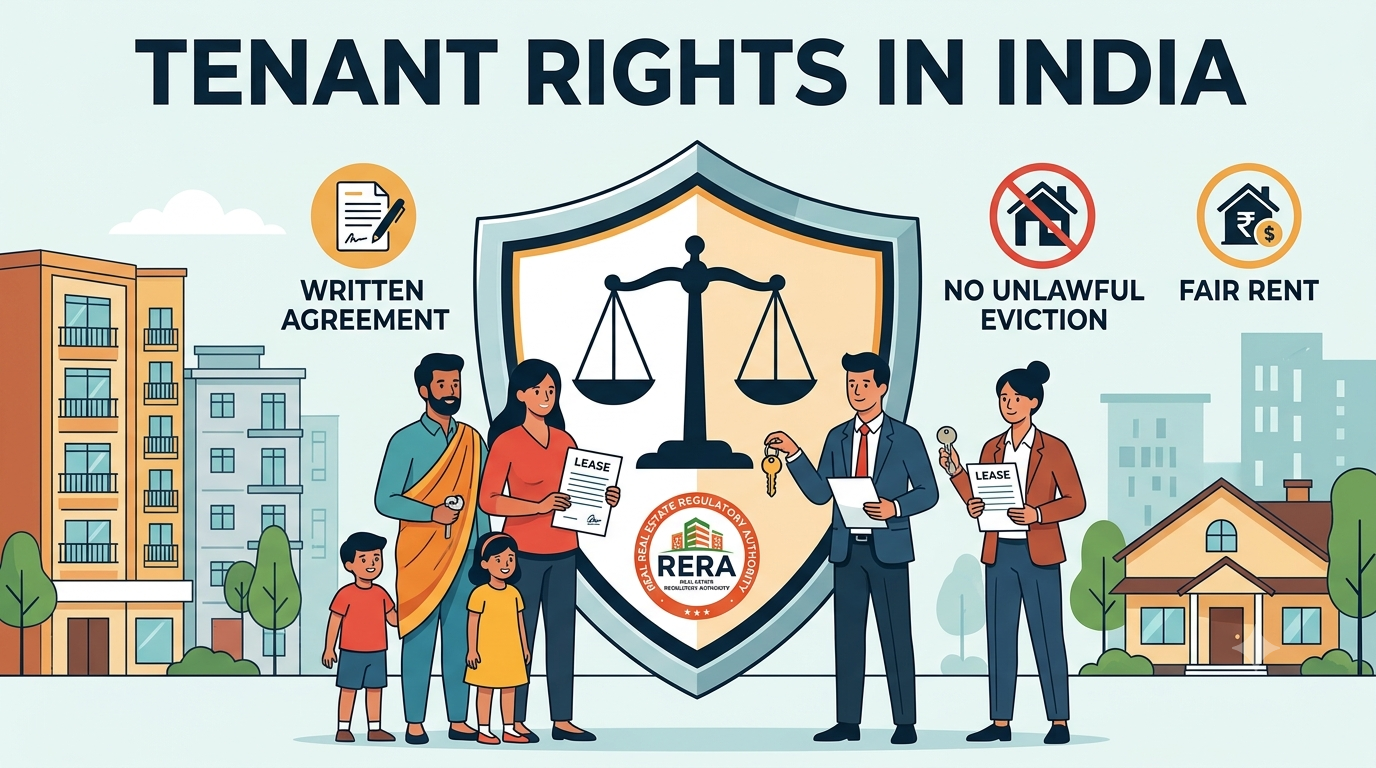
Renting a home gives you more than just a place to live. As a tenant, you enter into a legal relationship with the landlord, and both parties have certain rights and responsibilities. Understanding Tenant Rights in India can help renters protect themselves from unfair practices, avoid disputes, and make informed decisions before signing a rental agreement.
Indian tenancy laws are not governed by one single law applicable in exactly the same way everywhere. State-specific rent and tenancy laws, the terms of the rental agreement, and general property law can all be relevant. The Model Tenancy Act, 2021, was prepared by the Ministry of Housing and Urban Affairs as a framework for states and Union Territories to adopt or adapt, rather than automatically becoming a nationwide tenancy law.
Right to a Written Rental Agreement
One of the most important Tenant Rights in India is the ability to have the terms of the tenancy clearly documented. A written rental agreement should generally mention the monthly rent, security deposit, duration of tenancy, notice period, maintenance responsibilities, and other agreed conditions.
A properly drafted agreement can reduce misunderstandings between landlords and tenants. Before signing, tenants should carefully check clauses relating to rent increases, termination, repairs, subletting, utilities, and the return of the security deposit.
Right to Know the Terms of Rent and Deposit
Tenants should clearly understand how much rent they are required to pay and when it is due. The agreement should also explain the amount of the security deposit and the conditions under which deductions may be made.
Rules relating to deposits, rent increases, and refunds can vary depending on the applicable state tenancy law and agreement. Therefore, tenants should not rely on assumptions or general claims that apply uniformly across India.
Right to Peaceful Possession
Another important aspect of Tenant Rights in India is peaceful enjoyment of the rented property during the agreed tenancy period, subject to the terms of the agreement and applicable law.
Under Section 108 of the Transfer of Property Act, 1882, a lessor is generally required to allow the lessee to hold the property during the period of the lease without interruption, provided the tenant fulfils the applicable contractual obligations.
This means a landlord should not simply interfere with the tenant’s lawful possession without following the applicable legal and contractual process.
Right to Necessary Repairs
Maintenance responsibilities should ideally be clearly stated in the rental agreement. Depending on the circumstances and applicable law, certain repairs may be the landlord’s responsibility, while minor repairs or damage caused by the tenant may be the tenant’s responsibility.
The Transfer of Property Act provides that, in specified circumstances, if a lessor neglects repairs they are bound to make after receiving notice, the lessee may undertake the repairs and recover or deduct the permitted expense in accordance with the law.
Tenants should therefore document repair requests and keep records of communications, bills, and payments.
Protection Against Unfair Eviction
Understanding Tenant Rights in India is especially important when a landlord asks a tenant to leave.
A landlord generally cannot assume that a tenant can be removed instantly simply because the landlord wants possession. The actual procedure and grounds for termination or eviction depend on the applicable state law, the rental agreement, and the nature of the tenancy.
Tenants facing an eviction dispute should carefully review their agreement and obtain appropriate legal advice rather than ignoring notices or relying solely on informal conversations.
Right to Receive Proper Notice
Notice requirements are an important part of many tenancy arrangements. The rental agreement may specify how much notice the landlord or tenant must provide before ending the tenancy.
Where the agreement does not fully address the issue, applicable law may determine the notice requirements. The Transfer of Property Act contains provisions concerning determination of leases, but state-specific tenancy legislation and the actual terms of the tenancy may also be relevant.
Tenants should always check the notice clause before moving out or responding to a termination request.
Right to a Fair Process for Security Deposit Issues
At the end of a tenancy, tenants should expect the security deposit to be dealt with according to the agreement and applicable law. Legitimate deductions may be possible for unpaid rent, damage beyond normal wear and tear, or other agreed liabilities.
To protect themselves, tenants should take photographs or videos of the property when moving in and again before leaving. Keeping rent receipts, utility bills, repair records, and communication with the landlord can also be valuable if a dispute arises.
Tenant Responsibilities Matter Too
Tenant Rights in India come with corresponding responsibilities. Tenants are generally expected to pay rent on time, maintain the property properly, follow the agreed terms, avoid causing unlawful damage, and return possession when the tenancy legally ends.
The Transfer of Property Act also sets out various obligations of lessees, including restrictions concerning permanent structures and the obligation to return possession when the lease ends.
Following the rental agreement and keeping proper documentation can help both parties avoid unnecessary disputes.
What Should You Do If Your Rights Are Violated
If you believe your rights as a tenant have been violated, begin by collecting relevant documents. Keep a copy of the rental agreement, rent payment records, security deposit details, photographs, notices, messages, emails, and repair requests.
Try to communicate with the landlord in writing so that there is a clear record of the issue. If the dispute cannot be resolved, the appropriate legal remedy will depend on the circumstances and the law applicable in the relevant state.
For assistance in understanding rental disputes, agreements, notices, or other legal concerns, you can seek professional guidance through legal advisory services.
Knowing Tenant Rights in India can help renters approach a tenancy with greater confidence and awareness. A clear rental agreement, timely rent payments, proper documentation, and knowledge of applicable state laws can significantly reduce the risk of disputes.
At the same time, tenancy law can be fact-specific. The rules applicable to one state or type of tenancy may not necessarily apply to another. If you are facing an eviction notice, deposit dispute, repair issue, or disagreement with your landlord, obtaining advice based on the specific facts of your situation can help you understand the legal options available to you.
Disclaimer: This article is intended for general informational purposes and does not constitute legal advice. Tenancy laws and procedures may differ between states and Union Territories, so readers should seek qualified legal advice for specific situations.

Rinu Ann George is an SEO Analyst at Upgraderz,Specializing in Search Engine Optimization,Content Strategy and Digital Visibility.